

Moving Beyond Keywords: Adopting Semantic Search and User Intent Optimisation
If your SEO strategy still revolves around matching exact keywords and hoping for results, then it’s time to rethink your decision. Previously, SEO was all about placing the keywords in the meta tags, title, headings and a few times in the content. Then, with a few backlinks, it was easier to climb the rankings.
This approach does not work today. If you are still following this SEO plan for your business, you are already a step behind in how modern search engines work.
Search engines are now witnessing a drastic shift. Nowadays, it is not just about simply matching keywords. Google now uses an advanced language processing system and AI models to understand context, intent and relevance.
A leading SEO agency in Kolkata, BUSFAM, is adopting two major approaches to keep pace with the latest trends: semantic search and user intent optimisation.
Understanding Semantic Search
Semantic search is the ability that focuses on understanding the contextual meaning and intent behind a user’s search query, rather than only matching keywords. It aims to deliver highly relevant search results that satisfy the user's information needs.
Take, for example, if you are looking for the “best SEO agencies in Kolkata”, a semantic search engine would try to interpret the search as the user is looking for a reliable and result-driven SEO partner for their business.
What is User Intent Optimisation?
User intent optimisation is the process of creating and structuring content so that it directly matches what a user is actually trying to achieve when they type a search query into a search engine.
Instead of focusing on inserting keywords, it focuses on understanding the purpose behind the search and delivering the most relevant answer, solution, or action.
In simpler terms, user intent optimisation means answering the why behind the search rather than just the what.
How Semantic Search Works and Its Benefits
Semantic search works by combining multiple technologies to help the search engines interpret the language like a human. An SEO agency in Kolkata explains how the process works.
Query Analysis: The search engine uses natural language processing to break down the query and identify keywords, phrases and entities related to it.
User Intent Analysis: The system then determines why the user is searching and tailors the results based on the most likely intent behind the search.
Content Analysis: Just like how a search engine analyses queries, it also examines the content of web pages to determine their relevance to a particular search, which considers factors such as the overall topic, sentiment, and entities mentioned within the content.
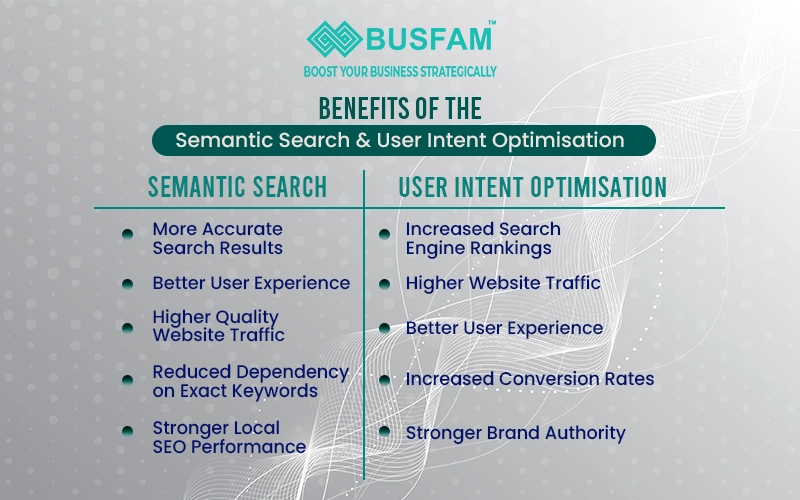
Here are the core advantages of this approach
- More accurate search results that greatly improve the relevance of the search
- Better user experience by showing answers that cater to their needs rather than keyword-heavy pages.
- Higher quality website traffic who are genuinely interested in your products and services
- Reduced dependency on exact keywords to focus on topics, context and depth
- Stronger local SEO performance to help connect users with the most relevant local businesses
How Does the User Intent Optimisation Process Work?
User intent optimisation is a step-by-step process to analyse search behaviour and adjust the website.
Identify the Intent Category: First, understand what the user is searching for. For example, the audience might try to seek content related to information, education, transactional or even commercial.
Analyse Search Behaviour and Pattern: Look at search patterns, click-through rates, bounce rates, and dwell time. You can use tools like Google Search Console to reveal how users interact with your site. For instance, if the users frequently bounce after visiting a product page, it may indicate that the content doesn’t match their transactional intent.
Map Intent: Another important step is to align the search query with the right content format. For example, if the user is searching for something informational, show results like blogs, FAQs and guides. On the other hand, if it is transactional, the content pathway must be product pages and CTAs.
Optimise Content Structure: Always optimise the content structure. In addition to maintaining a proper flow, use headings, semantic search, titles and schema markup to make the content readable.
Continuous Optimisation: User intent is dynamic; hence, it is essential to regularly update content based on search trends, voice queries and AI-driven search engine updates. This ensures your site remains aligned with evolving user expectations.
Now, let’s take a look at the benefits of user intent optimisation.
BUSFAM, an expert SEO agency in Kolkata, lists the advantages of user intent optimisation.
- Increased search engine rankings that meet user expectations.
- Higher website traffic who are genuinely interested in your products, information and services.
- Better user experience with reduced bounce rates and more engagement with the website.
- Increased conversion rates and higher return on investment (ROI).
- Stronger brand authority, encouraging repeated visits and loyal customers
- More targeted and strategic content that meets requirements.
Conclusion
SEO is no longer about keywords. The shift to a semantic search engine and user intent optimisation has become crucial to businesses seeking online presence and engagement.
To achieve the best results, it is better to work with an experienced SEO agency in Kolkata, like BUSFAM, that can help companies implement modern SEO strategies that align with evolving search engine algorithms and user expectations.