

Why Your Site Isn’t Ranking: Core Technical SEO Fixes Every Site Needs
You have spent days creating a visually appealing website, creating content and building backlinks, only to find your website on Page 3 or 4 of Google. It is frustrating, right?
What many business owners don’t know is that great content and design do not always guarantee visibility. It is actually technical SEO that determines the ranking of your website.
Technical SEO goes beyond just keywords and meta descriptions. It ensures that the search engines can easily crawl, index and understand your website.
Without proper technical SEO, even outstanding content and design fail to reach their audience, and the site remains invisible. In this blog, professional SEO service provider BUSFAM has listed the core technical SEO fixes every site needs to boost its rankings.
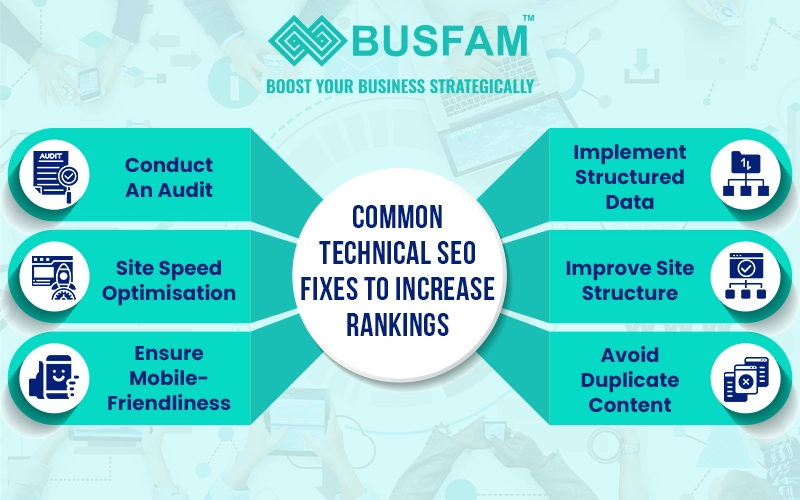
Common Technical SEO Fixes to Increase Rankings
1. Conduct an Audit
The first step, which is mostly overlooked, is conducting a comprehensive SEO audit to find out what’s wrong with your website. This includes reviewing your site structure, checking crawlability and indexation, and identifying broken links, duplicate content, or missing meta tags. You can use various Google tools to identify the exact issue to understand why your site is underperforming.
2. Site Speed Optimisation
Google always prioritises fast-loading websites. The websites that have slow-loading pages frustrate the visitors, resulting in increased bounce rate. Try to optimise your website by compressing the images without losing quality, leveraging the browsing cache, minimising the JavaScript and HTML files and using a content delivery network to reduce load times.
3. Ensure Mobile-Friendliness
Nearly half of the searches are done through mobile devices, which means that the websites must look good and work well on phones and tablets. When opting for professional SEO services, make sure that the website is mobile-friendly. The team at BUSFAM makes sure that every website has a mobile-friendly design and adjusts smoothly to different screen sizes. For example, the text should be readable without zooming, and buttons should be easy to tap without errors.
4. Implement Structured Data
Implementing structured data helps search engines to understand the content better. You can add schema markup for elements like products, services, reviews, articles, or FAQs. This improves indexing but also improves search results to make the listings stand out. As a result, the web pages attract more visitors, which can eventually turn into potential customers.
5. Improve Site Structure
A well-organised website helps search engines like Google to crawl and index the site effectively. It also improves user navigation, thereby helping visitors find relevant content quickly. Don’t forget to give importance to the important pages, and a clear internal linking strategy should be in place to connect related pages.
6. Avoid Duplicate Content
Duplicate content confuses the search engines and decreases rankings. When the same content is present on multiple pages, search engines often get confused about which version to index. To prevent this, it is better to use canonical tags to indicate the preferred version of a page, avoid publishing identical content across different URLs, and regularly audit your site to identify and fix duplicates.
Conclusion
Technical SEO is the foundation of your website’s visibility. By following these steps, you can identify the errors that are holding your site’s rankings. If you are still struggling, you can get in touch with BUSFAM, a reputable digital marketing agency providing professional SEO services to improve search engine rankings and attract traffic.